As a teacher, I was frustrated. I had been teaching for years and knew how to make my lessons creative, fun, engaging, and memorable. In my experience, kids were only mildly interested in what was going on IRL (meaning ‘in real life’ for us old fogies) and much more interested in TikTok Shop. Luckily, Texas finally passed a law that prohibited the use of student cell phones during the school day. So there was hope!
I knew I had to pivot somehow. I knew my creativity was my superpower, but at this point, it had become my greatest weakness. I kept reinventing the wheel with new activities from the Lead4ward bank. (Highly recommend, by the way!) I kept creating new activities that were engaging, but these activities changed daily. I knew that learning meant making connections, so using their cool lingo and influencer references was something I sprinkled in every now and again.
The problem was that by doing all of this, the learning process never became automatic for my students. They had to constantly guess at what “she wants this time” or what the end product was supposed to be. And it showed. I would grade their work and some of what they produced would be right in one sense, but not right for the actual objective. Or, the work would be spot-on, but not at the level of rigor I had been aiming for.
And what was I supposed to expect? The activities kept changing, even if the thinking never did. I was unintentionally putting a mental load on my students that didn’t need to be there. Because here is the thing that finally clicked for me: in my effort to keep the learning from being boring, I was asking students to figure out the learning process while also asking them to understand the actual learning itself. Holy cow! No wonder it was a lot. No wonder my students were trying, seemed to get it, but couldn’t really transfer the concept into the higher-level thinking I needed them to.
So, I switched things up. Mid-year, and like a mad woman. I looked at my style of lessons, and decided that it was time to get ruthless. What absolutely needed to be there? What was superfluous or fluff and was just crowding the actual learning? That! That needed to go. The engagement activity that was fun in theory, but actually took 10 extra minutes to coordinate? Gone. The neat bell ringer idea I just found on Facebook, but would have caused more set up for them and me? Out.
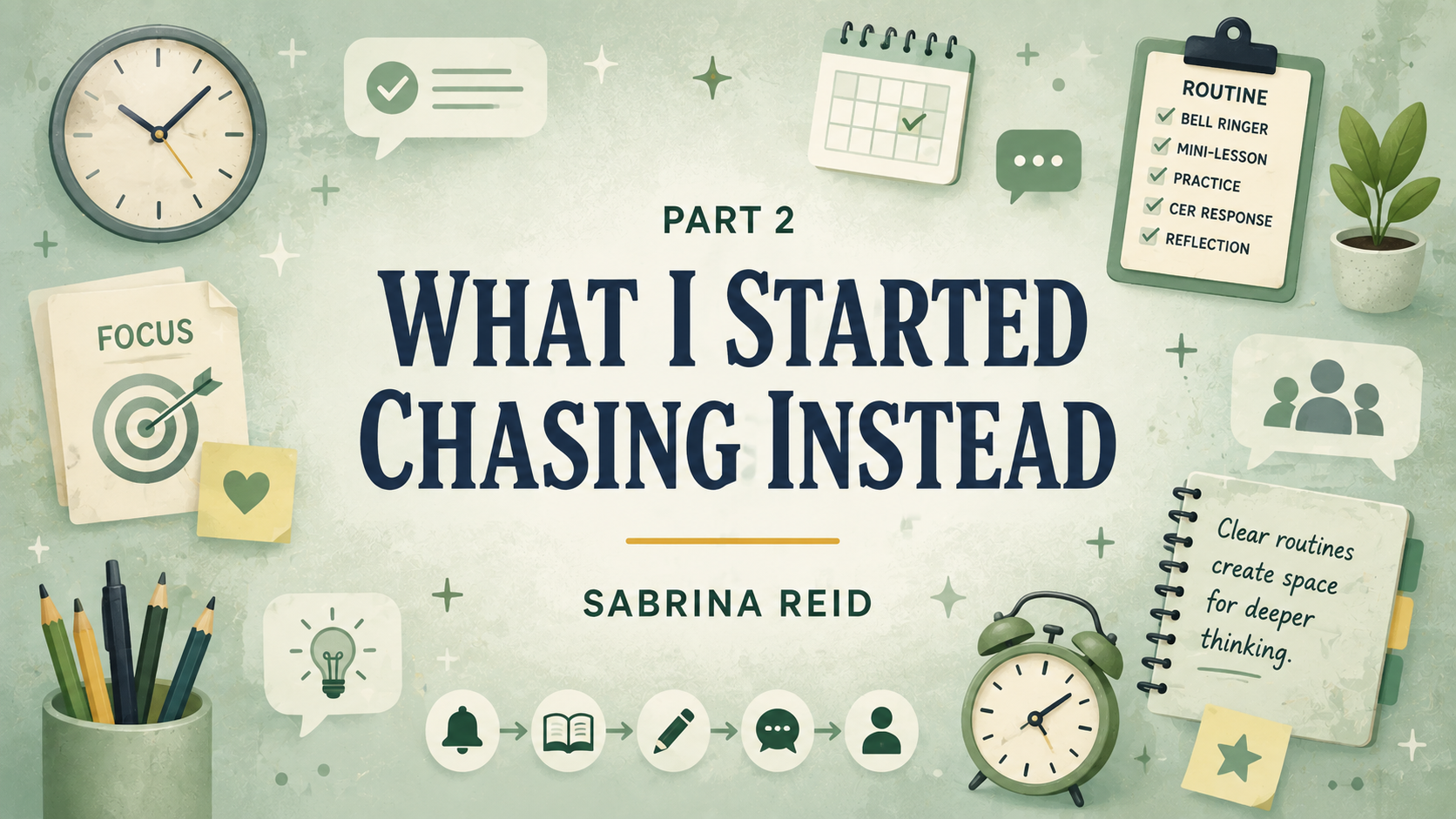
I made my learning procedures not boring, but predictable. We worked our bell ringers the same way every morning. A good answer meant the same thing every time. The worksheets, if that is where the practice was happening that day, became more uniform. Even my slides in my presentation began to have a cadence to them. Certain information was presented in the same way visually, every day. The lesson cycles themselves became so obviously the same every day that students could have eventually run the classroom schedule themselves.
Student 1: “What do we do now?”
Sassy Student 2: “You know we do the CER response next. I don’t know why you bother asking!” (Insert middle school eye roll here.)
While this sounds stringent, what I found was freedom because the predictability freed up the students’ memory. They weren’t having to navigate the task before they could even do the thinking. It alleviated uncertainty and anxiety. I didn’t have students worried about what this next new thing was going to be about. The familiarity was already there. It reduced behavior problems. It was a lot harder to have students hide behind not knowing what to do or where to be when the class is more streamlined. On my end, my eyes got used to seeing a certain format during certain parts of the class, so knucklehead behavior was amplified. And…this is the big one…it unlocked more creativity, problem-solving skills, and ownership from the students.
They knew the learning format, and after a while, it became second nature. So students would suggest their own spin on an activity. Sometimes, their ideas worked, and sometimes they didn’t. But what was happening underneath their suggestions was that they were attempting to have a hand in how they learned. The much more simplified classroom routines I created allowed them a way to look at how we learned and asked if it could be done differently or with different results. Suddenly, my students were looking at things like test review and asking how they could make it more challenging.
All in all, reducing the amount of new activities and streamlining learning routines was a success for me. I didn’t lower the cognitive demand. I lowered the procedural demand. That put the effort where I wanted it: on the content, not figuring out how to complete the task. My routines became almost invisible after a while so that the actual learning could become visible. Students began asking “What are we learning today?” instead of “What are we doing today?” That became refreshing for me and the students. And in the age of pings and notifications and snaps and DMs, a little less competition for our working memory is something we all could probably benefit from.
Leave a Reply